


Have you ever wondered if your company is invisible to the millions of people scrolling through their phones right now? Adults now spend over 186 minutes every day on social media platforms. This high level of engagement makes social media marketing a vital tool for every modern business.
Data shows that 43.1% of users visit these sites specifically to research or learn about brands. This means paid advertising is a natural way for small businesses to gain visibility. We believe that a smart marketing plan helps you compete with much larger names without overspending.
This guide outlines a practical social media ad campaigns strategy for small business success. You will learn to build a strategy that generates leads and increases revenue. Our goal is to help you master social media without wasting your precious budget on marketing that fails to deliver.
By the end, you will see how social media connects you with the 51% of people discovering brands online. Let’s start your journey toward better business results on social media. After all, consistent social media marketing is the key to a growing business.
Key Takeaways
- Reach active customers where they already spend three hours every day.
- Use paid ads as a natural path for brand discovery and research.
- Follow a six-step framework to drive real leads and sales revenue.
- Compete with larger brands through smart targeting and creative execution.
- Maximize your budget by making data-driven decisions instead of guessing.
- Focus on clarity and consistency to build long-term digital growth.
Why Social Media Ad Campaigns Matter for Small Businesses
Many business owners worry that social media marketing is a waste of funds, yet the data shows it is a vital growth engine. Currently, 83% of marketing leaders rely on social advertising as a primary channel to communicate with their audience. We believe that owners who embrace this media marketing strategy can find business success much faster than those who rely on luck alone.
The Power of Paid Social Media Marketing
Research from the Pew Research Center indicates that most American adults spend their time on social media platforms like YouTube and Facebook. Since 48% of customers prefer using these channels to learn about small businesses, your presence there is non-negotiable. Using social media ads ensures your brand appears where your marketing can actually be seen by active users.
Paid social media allows businesses to reach beyond their current followers. This expansion creates a consistent flow of awareness that organic posts simply cannot provide on their own.
Cost-Effective Reach and Precise Targeting Capabilities
You do not need a massive budget to see a real return on your investment. Many businesses start with just $5 to $10 per day to test their creative ideas. This allows you to reach people based on their specific interests, location, and shopping behaviors.
Over 60% of marketers use these media tools to improve how they segment their audience. We can help you focus your spend on the individuals most likely to buy your products.
| Metric Type | Statistic | Business Impact |
|---|---|---|
| Adoption Rate | 83% | Standard for industry leaders |
| Targeting Use | 60% | Better audience segmentation |
| Growth Success | 45% | Meaningful business growth |
Bridging the Gap Between Organic Content and Paid Advertising
Organic reach has declined across almost all platforms, making it harder for your message to break through. Paid ads bridge this gap by amplifying your top content to a wider audience. This strategy drives sales and increases brand awareness by keeping your social media presence active 24/7.
Real Results: How Small Businesses Succeed with Social Ads
A recent TikTok survey found that 45% of small businesses attribute a meaningful portion of their success to the platform. This proves that social media is a level playing field where smart strategy wins. Media marketing allows you to compete with larger marketing budgets by being more relevant to your customers.
Social advertising is no longer just an option; it is the bridge between a great product and the right customer.
By using media strategically, you turn social media from a time-sink into a lead-generation machine. We are here to ensure your social media efforts result in tangible growth rather than wasted media spend.
Step 1: Define Your Social Media Advertising Goals
Every successful campaign starts with a firm decision on what success looks like for your business. Without clear targets, you risk wasting money on unfocused efforts that fail to move the needle. We want to help you turn your advertising from guesswork into a data-driven strategy.
Establishing these benchmarks early ensures every dollar spent serves a specific purpose. This guide will help you clarify your vision before you launch your first creative asset.
Setting SMART Goals for Your Ad Campaigns
We recommend using the SMART framework to ground your ambitions in reality. This means your objectives must be Specific, Measurable, Achievable, Relevant, and Time-bound. For example, instead of saying you want “more marketing impact,” aim for something you can actually track.

A concrete SMART goal might be to increase website traffic by 30% within the next 90 days. You could also aim to generate 50 qualified leads per month to keep your sales team busy. These specific results allow you to adjust your tactics based on real performance data.
“A goal without a plan is just a wish.”
Common Advertising Objectives for Small Businesses
Most social media objectives fall into three main categories: awareness, consideration, and conversion. A new shop might prioritize brand awareness to reach fresh audiences who have never heard of them. An established firm may focus on awareness of a new product line to spark interest.
- Awareness: Reaching new people and increasing brand visibility.
- Consideration: Driving engagement, app installs, or website visits.
- Conversion: Boosting online sales, sign-ups, or service bookings.
Aligning Ad Goals with Overall Business Objectives
Your social media efforts should always mirror your current business priorities. If you need immediate revenue, focus your marketing budget on high-intent conversion campaigns. If you are building a community, prioritize growing and engaging with your audience over direct sales.
| Business Priority | Campaign Goal | Key Metric |
|---|---|---|
| Grow Reach | Brand Awareness | Impressions |
| Find Leads | Lead Generation | Form Submissions |
| Increase Revenue | Conversions | Purchase Count |
Start with one or two focused goals rather than trying to achieve everything at once. This focus helps you learn which social media tactics work best for your specific niche. Clear goals lead to better social media optimization and long-term growth.
Step 2: Identify and Research Your Target Audience
In 2025, reaching everyone is a recipe for failure; instead, focus on the specific niche that loves your product. Small businesses often waste money by trying to appeal to the widest possible group.
We recommend a different path for your social media strategy. Effective targeting starts with knowing exactly who your ideal customer is, including their behaviors and pain points.
Narrowing your focus helps you build authentic connections that lead to real business results. Understanding your audience allows you to create marketing content that speaks directly to them.
Creating Detailed Buyer Personas for Ad Targeting
Start by looking at your best existing customers. Work backward to identify the common traits that define your ideal target audience.
Create detailed personas that include age, location, and buying behaviors specific to your business. This helps you visualize the people you want to attract with your ads.
Understanding Audience Demographics and Psychographics
Successful media campaigns require a deep dive into both demographics and psychographics. Demographics provide the “who,” while psychographics explain the “why” behind a purchase.
| Factor | Demographics | Psychographics |
|---|---|---|
| Focus | Age, Gender, Income | Values, Interests, Lifestyle |
| Benefit | Broad filtering | Emotional resonance |
| Goal | Reach the right person | Connect with the right mind |
Both categories matter because they help you refine your target parameters. Use these details to ensure your message fits the lifestyle of your prospective customers.
Leveraging Platform Analytics and Social Listening Tools
Use platform analytics tools to see who currently engages with your posts. These platforms offer sophisticated data on which segments convert best for your business.
Social listening serves as a way to discover what your audience talks about online. These tools reveal the problems they need solved and the specific language they use.
“Narrow, specific targeting always outperforms a spray and pray approach for small budgets.”
Analyzing Competitor Audiences for Insights
Look at your competitors to find gaps you can fill in the market. Analyze who follows them and what content gets the most engagement from their social media followers.
Researching the audience is an ongoing process that improves over time. As you gather data, you can use features like lookalike audiences to find more people similar to your top customers.
- Identify pain points your competitors ignore.
- Monitor trending topics within your niche media circles.
- Adjust your social media spend based on performance data.
Step 3: Choose the Right Social Media Platforms for Your Ads
Instead of trying to be everywhere at once, small business owners should focus on the specific networks where their customers actually spend time. Focus beats dilution every time when it comes to your media marketing strategy. We recommend starting with just one or two social media platforms where your audience is most active.
Choosing the right platforms allows you to spend your budget more effectively. Spreading resources too thin across every social media channel often leads to poor results. By selecting the best platform for your needs, you ensure your message reaches the right people.

Facebook and Instagram Ads for B2C Businesses
Facebook remains the most popular platform for small business marketing worldwide. It offers the largest user base and sophisticated target options that benefit local businesses. These ads allow you to reach specific demographics with diverse formats.
Instagram is a visual-first social media channel. It is highly effective for businesses with strong visual products or lifestyle brands. If your content relies on high-quality imagery, this is where you will find younger demographics.
LinkedIn Ads for B2B Marketing and Professional Services
LinkedIn is the primary social media site for B2B marketing. It allows you to reach decision-makers with higher-value offerings. If your business provides professional services, this media environment is typically more effective for lead generation.
TikTok Ads for Reaching Younger Demographics
TikTok is a rapidly growing media channel for creative content. It makes a concerted effort to connect with small owners by showcasing success stories. This platform is perfect for reaching Gen Z and younger Millennials through authentic, short-form video.
YouTube Ads for Video-First Marketing
YouTube provides powerful video advertising capabilities. It works well for brands that can invest in video content. You can reach a wide audience while they are already consuming digital media.
Platform Selection Based on Your Audience and Goals
Your choice should reflect where your audience lives and what your marketing goals are. Awareness campaigns work differently than direct response on these social media platforms. Always let data and testing guide your decisions in media marketing.
Different platforms require different creative approaches to succeed. Some media types favor long-form video, while others work best with quick snapshots. Ensure your chosen media aligns with your internal team’s strengths.
Finally, check where your competitors are seeing success. Use these platforms to benchmark your own growth. Stick to the platforms that provide the highest return on investment.
| Platform | Primary Audience | Main Strength |
|---|---|---|
| Broad Demographics | Precise Local Targeting | |
| Millennials & Gen Z | Visual Storytelling | |
| B2B Professionals | Lead Generation | |
| TikTok | Gen Z | Authentic Engagement |
Step 4: Set Your Advertising Budget and Bidding Strategy
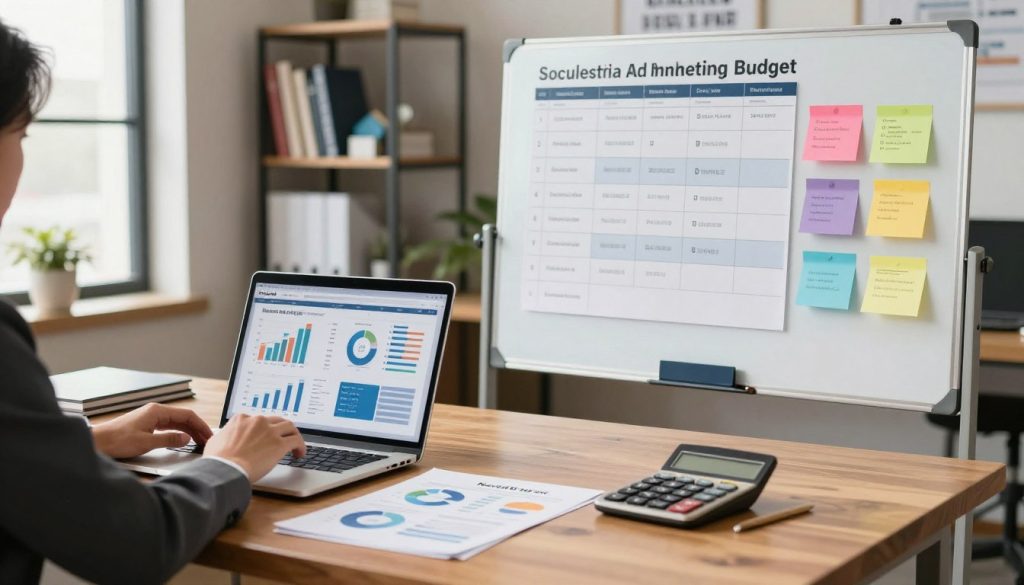
Managing your advertising costs requires a balance between testing new ideas and scaling what actually drives sales. We believe that financial clarity helps a business grow without unnecessary stress. Recent data shows that 81% of SMBs planned to increase their investment in paid social by late 2024, proving that results come to those who invest in social media marketing wisely.
Determining Your Initial Ad Spend Budget
You do not need a massive bank account to begin your journey in media marketing. Most small owners start with just $5 to $10 per day to test their creative assets without overspending. This approach gives you enough time to see which messages resonate before committing more funds.
A monthly budget of $300 to $500 is often the “sweet spot” for meaningful results. This level of marketing spend allows the platform algorithms to learn about your audience. We suggest starting small and only increasing your investment once you see a clear return.
Understanding Bidding Options: CPC, CPM, and CPA
Choosing the right bid type depends on your specific goals. CPC (Cost Per Click) works best when you want to drive traffic directly to your website or products. CPM (Cost Per Mille) focuses on brand awareness by charging for every thousand impressions.
| Bid Type | Best For | Primary Objective |
|---|---|---|
| CPC | Website Traffic | Clicks to Product Pages |
| CPM | Brand Exposure | Maximum Visibility |
| CPA | Conversions | Sign-ups or Purchases |
Allocating Budget Across Platforms and Campaigns
Avoid splitting your budget evenly across all social media marketing channels by default. Instead, allocate more money to platforms where your audience is most active. Identify your top-performing organic posts and use them as a low-risk way to start with boosted content.
Keep separate budgets for testing and proven campaigns. This ensures that your primary goals are met while you still find new opportunities. Always prioritize the platform that delivers the lowest cost per customer acquisition.
When to Scale Your Ad Spend
Scaling should only happen once you prove a concept works. Look for a consistent positive ROI and a stable cost per result over time. If your performance is inconsistent, it is better to pause and refine your strategy.
When you find a winning ad, increase your spending slowly to maintain stability. This disciplined approach to media marketing protects your business from sudden losses. Success is about sustainable growth, not just spending more money quickly.
“Profitability is the only metric that truly justifies a budget increase in digital marketing.”
Social Media Ad Campaigns Strategy for Small Business: Creating Compelling Ad Content
High-quality creative elements often matter much more than a massive production budget. Authentic and relevant content usually outperforms polished but generic media that feels like a standard commercial. We focus on making sure your social media presence feels real and relatable to your audience.
Creating visually appealing graphics and captions that truly resonate is the heart of social media strategy. You do not need professional design skills to get started. Simple tools can help you with content sourcing and repurposing to enhance your reach across various media channels.
Crafting Attention-Grabbing Ad Copy That Converts
Writing ad copy involves more than just listing the features of your business. Start with a strong hook in the first line that addresses specific customers and their pain points. This helps your post stand out in a crowded feed.
Use a simple formula for your content: grab attention, communicate value quickly, and overcome common objections. Speak directly to the needs of your audience to build immediate trust. Ending with a clear instruction ensures the reader knows exactly what to do next.
Designing Visual Assets That Stop the Scroll
To stop the scroll, use high-quality images and ensure they are optimized for mobile viewing. High contrast and bright colors can make your ads much more noticeable. We recommend including human faces whenever possible to create a personal connection with customers.

Consistent visual styles across all your posts help build recognition over time. Always test different images to see which ones your followers prefer. Simple, clean designs often perform better than cluttered graphics that confuse the viewer.
Creating Video Ads That Engage Your Target Audience
Data shows that video and carousel posts get the highest engagement across most platforms. You can show your products in action or share quick tips to provide immediate value. Authentic, “behind-the-scenes” content often builds a stronger bond than high-end productions.
Hootsuite’s original research found that carousels and videos come out on top for content performance.
Interestingly, 43% of brand owners recently tried a new tone of voice or persona in their media efforts. This suggests that experimenting with how you speak to people is now a standard practice. Use social media to test new ways of telling your business story.
| Format Type | Engagement Level | Best Use Case |
|---|---|---|
| Video | High | Product Demos |
| Carousel | High | Storytelling |
| Single Image | Medium | Quick Updates |
Writing Strong Calls-to-Action That Drive Results
A strong call-to-action (CTA) uses specific action verbs to guide the audience. It should offer a clear value proposition and create a sense of urgency. For example, use “Claim your discount today” instead of a generic “Learn more” button.
Make sure the next step is friction-free for the user. If they click your social media link, the landing page must match the promise of the ad. This alignment is vital for turning clicks into actual sales and results.
Ensuring Brand Consistency Across All Ad Creative
Consistency means using the same colors, fonts, and tone across every post you share. This allows people to recognize your brand instantly when they see your content. It builds long-term engagement and professional credibility.
We suggest testing different headlines and video lengths to find your “sweet spot.” Even a small change in a brand message can lead to better performance. Use these media insights to constantly improve your posts and grow your business.
Step 5: Launch and Monitor Your Ad Campaigns
Launching your social media ad campaigns is a pivotal moment where your strategy finally meets the public eye. Transitioning from the creative phase to the technical setup requires focus to ensure every dollar works hard for your business.
We recommend using tools like Hootsuite to streamline this process. Their platform allows you to schedule content and manage multiple accounts from one central dashboard, saving you hours of manual work.
Setting Up Your Ad Campaigns in Platform Ad Managers
To begin, you must access the specific ad manager for your chosen platforms, such as Facebook Ads Manager or TikTok Ads Manager. Each platform provides a structured workflow where you select your objective, name the campaign, and set your daily budget.
Once you define your target parameters, you will upload your creative assets and launch. For the best engagement, many experts suggest scheduling your initial posts for noon on Fridays, though your specific data should always be the final guide.
Configuring Advanced Targeting Parameters and Placements
Advanced media strategies go beyond basic age and location filters. You can upload email lists to create custom audiences or build lookalike groups to find new customers who resemble your best buyers.
Deciding where your ads appear is just as important as who sees them. You can use automatic placements or manually select specific areas like Instagram Reels or the LinkedIn feed to control the user experience.
Implementing A/B Testing for Ad Variations
Effective testing is the secret to lowering costs over time. Always test one variable at a time, such as comparing two different headlines or two different images, while keeping everything else the same.
Ensure your social media tests run long enough to gather significant data. We suggest letting campaigns run for at least three to five days before making any major changes to the settings or content.
Monitoring Real-Time Campaign Performance
Checking your social media ads daily during the first week helps you catch delivery issues early. Watch your click-through rate and cost per click to ensure your audience finds the content relevant and helpful.
Hootsuite Composer can further assist by using OwlyWriter AI and hashtag generators to keep your posts fresh. This approach ensures your business maintains a high-quality presence across all social media channels without the stress of constant manual updates.
| Ad Manager | Primary Platform | Top Advantage |
|---|---|---|
| Ads Manager | Facebook & Instagram | Deep Demographic Data |
| Campaign Manager | Professional B2B Targeting | |
| TikTok Ads Manager | TikTok | High Creative Engagement |
Step 6: Measure Performance and Optimize Your Results
Smart business owners treat every ad as an experiment that provides valuable data for future growth. Launching your campaign is a great start, but true success comes from interpreting the results correctly. We recommend a proactive way to manage your budget by focusing on high-impact data that aligns with your goals. This ongoing strategy ensures your social media presence remains both profitable and relevant.
Key Metrics to Track for Ad Campaign Success
Distinguish between “vanity” and “actionable” metrics to understand your true performance. Likes and comments show engagement, but they do not always lead to direct sales. Focus on conversion rates and cost per acquisition to see how effectively your marketing dollars convert. We track how customers interact with your brand to ensure the success of every dollar spent.
Monitoring the right numbers prevents you from chasing popularity instead of profit. High engagement is useful for proof, but ROI keeps the doors open. Always connect these small wins to your larger financial objectives.
Using Analytics to Identify High-Performing Ads
Detailed analytics help you see which posts resonate most with your target audience. Look for specific patterns in your media assets to find out what drives the most growth. By aligning these findings with your marketing plan, you ensure every creative choice supports the business. Analytics provide the clarity needed to stop guessing and start knowing what works.
Continuous Optimization Techniques for Better ROI
Optimization is an ongoing process of refining your strategy to reduce waste. If a specific ad underperforms, refresh the creative or adjust the targeting parameters to boost engagement. We use these insights to prove concepts and learn exactly what your business audience prefers. This constant cycle of testing and analytics refinement builds a stronger competitive advantage over time.
Scaling Winning Campaigns and Cutting Underperformers
Scale up campaigns that consistently meet your goals by slowly increasing their budget. You can also expand to lookalike audiences to find more people similar to your best social media followers. Conversely, cut posts that fail to produce after a full week of testing. This disciplined approach to media management keeps your budget focused only on high-performing assets.
| Metric Category | Platform Benchmarks (Weekly) | Primary Focus |
|---|---|---|
| Facebook Growth | 14.53% Growth | Reach and Engagement |
| TikTok Growth | 3.24% Growth | Video Analytics |
| Instagram Growth | 1.37% Growth | Visuals and Comments |
| LinkedIn Growth | 0.85% Growth | Professional Media |
Conclusion

While many business owners once hesitated to enter the social media space, it has now become a necessary path for meaningful growth. Starting earnest and authentic conversations on a digital page is the most important way to begin. You do not need a perfect plan or a massive budget to find success in the current market.
This guide has shown that social media marketing offers small businesses a cost-effective way to reach specific groups. By following our six-step strategy, you can turn a modest budget into a powerful lead-generation tool. Consistency and consistent optimization over time will always beat a one-time viral example.
Success requires clarity on your goals and a deep understanding of your audience. Revisit this guide often to recap the framework: define goals, research audience, and choose the right media platforms. Then, set a realistic budget, create scroll-stopping content, and monitor your results.
Focus on one product and one objective at a time to stay efficient and reduce overwhelm for busy owners. The behind the scenes reality of a winning campaign involves testing, learning, and making data-driven shifts on your landing page. Watching these scenes unfold in your data helps you improve your approach over time.
Do not let complex tips or technical jargon stop you from claiming your spot in the digital world. Real results happen when you move from watching the market to actively participating in it. Whether you are tracking clicks or responding to helpful comments, every interaction provides valuable data for your marketing efforts.
Your business deserves a strategy that works as hard as you do every day. If you want expert guidance to build profitable campaigns, we are here to help businesses succeed. North Layer specializes in helping small businesses reach their full potential without wasting their hard-earned money.
Contact North Layer to book a Growth Call and get started today to see real results. You can also reach us directly at hello@northlayer.co for personalized strategy support. Let us help you turn your social media presence into a sustainable engine for your business.



